Pick a company offsite game for the gap in your agenda, not because someone called it a team-building essential. A short drawing game can fill the break between workshops. A scavenger hunt needs its own block. Neither will fix a team that needed a lighter schedule in the first place.
Below are seven options for office group games, team days, and larger company events. Music bingo is one of them. If you want quiet conversation or have no reliable sound system, choose something else.
Choose by time, space, and effort
These are suggested planning ranges, not tested capacity limits or promised timings. Allow extra time for instructions, access needs, and moving between rooms. For a larger crowd, repeat the activity at separate tables rather than assuming one host can manage everyone.
| Activity | Suggested play block | Suggested total group | What you need | Skip it when |
|---|---|---|---|---|
| Common-ground challenge | 10 to 15 minutes | 6 to 30 | Prompts and paper | People have had enough introductions |
| Team trivia | 25 to 40 minutes | 8 to 60 | Questions, answer sheets, host | The questions favor one country or department |
| Drawing relay | 15 to 25 minutes | 6 to 30 | Paper and pens | A visual or drawing task excludes someone and no suitable adaptation is agreed |
| Paper tower challenge | 20 to 30 minutes | 8 to 40 | Paper, tape, tables | There is no comfortable way for everyone who wants to join to contribute |
| Scavenger hunt | 30 to 45 minutes | 8 to 40 | Clue sheets and a checked route | Access, weather, or venue rules make the route unsuitable |
| Music bingo | 35 to 50 minutes | 10 to 80 | Cards, playlist, speakers, host | Sound is a problem or the group wants quiet |
| Tabletop game stations | 30 to 60 minutes | 6 to 40 | Games, tables, rule summaries | You need the whole room to finish at exactly the same moment |
The play blocks include a short explanation and wrap-up, but not advance preparation. A trivia quiz or hunt takes more prep than handing out paper. Check your chosen version before adding it to the schedule.
1. Common-ground challenge
Use this at the start of a team day when people don’t know each other yet. Put people in groups of three to five and ask them to find two things they have in common beyond working for the same company. A shared snack opinion or favorite kind of weekend counts. Personal disclosures don’t.
Give each table a prompt sheet, a pen, and a few minutes to talk. Then invite each group to share one answer or pass. You can call it a challenge without keeping score.
Use low-stakes prompts about food, hobbies, or places people would like to visit. Skip this if the morning already includes introductions. Nobody needs to introduce themselves for the fourth time before lunch.
2. Team trivia
Trivia gives each table something to solve together without putting an individual on stage. For a simple version, prepare three rounds of five questions with a separate answer key. Mix topics, write questions in plain language, and read them aloud as well as displaying or printing them.
Use teams of four to six. Give a point per correct answer, collect answers after each round, and accept joint winners. Decide in advance whether phones are allowed so the host doesn’t have to referee an argument halfway through.
Avoid a quiz built entirely around company history. New hires won’t have much to contribute. For international teams, ask someone from another office to check the references before the event. If you can’t make the questions fair enough, use a collaborative paper challenge instead. Don’t award points for answering fastest if people need time to read or translate.
3. Drawing relay
This is the paper game where a phrase becomes a drawing, then someone else’s guess, then another drawing. Seat four to six people together. Give everyone a small stack of paper and ask them to write a harmless phrase such as “a penguin ordering coffee.”
Pass stacks one seat over. Each person draws the phrase, covers the original, and passes again. The next person writes what they think the drawing shows. Alternate until each stack has gone around the table, then let its owner show the sequence if they want.
Use thick pens and roomy paper. The fun is seeing how the phrase changes, not judging the artwork. Keep prompts fictional rather than making coworkers the subject. A partner can draw from someone’s description if they prefer, but choose another game if the visual format doesn’t suit the group.
4. Paper tower challenge
Give each team of three to five the same amount of paper and tape. Ask them to build a freestanding tower on a table. Set a build period, then test whether each tower stands without anyone holding it. If you want a winner, measure height and explain the measuring rule before you start.
Prepare identical kits, a timer, and a ruler. Keep everything on reachable tables. No climbing, standing on chairs, or attaching structures to the ceiling.
Leave a little time to test and rebuild before measuring. People can design, fold, assemble, or test, so let them choose their part. A collapsed paper tower doesn’t need to become a lecture about leadership.
5. Scavenger hunt
A hunt suits an offsite where exploring the venue is part of the point. Plan a small set of clues within a clearly marked area. Teams of three to five might find a detail in a mural, solve a clue at a sign, or copy a symbol from a designated stop.
Walk the route first, get the venue’s permission, and prepare paper clues so a phone isn’t required. Set a return time and an organizer contact. Score completed clues rather than speed. Nobody should be sprinting across a parking lot for a team prize.
Check step-free access, seating, distances, and the weather. Offer a seated puzzle version with the same clues available on paper. Keep tasks within the agreed area and avoid photos of strangers. If the route doesn’t work for the group, move the hunt indoors.
6. Music bingo
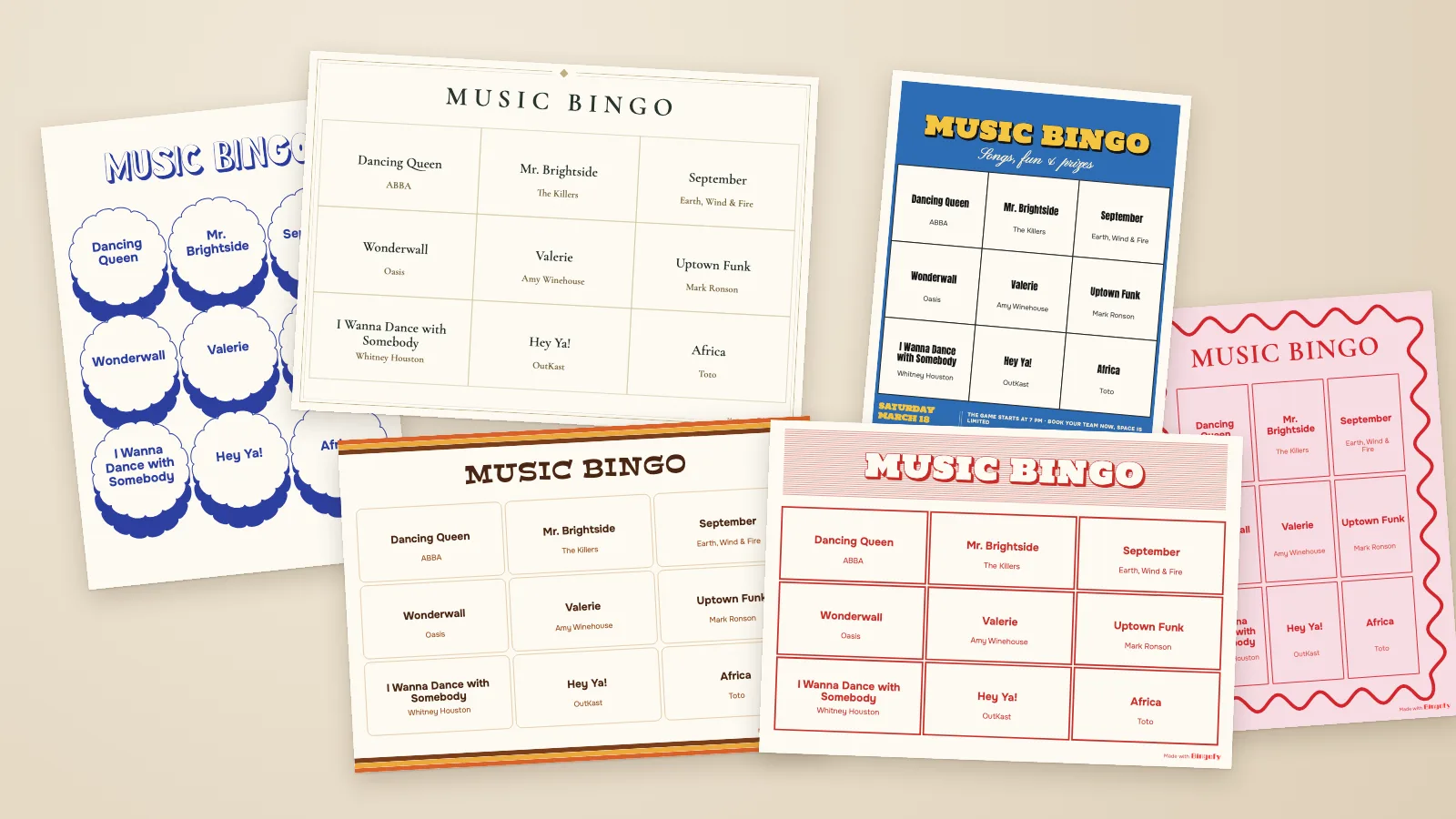
Music bingo fits a social block when you want a shared activity without asking people to sing. Players mark song titles on their cards as the host plays tracks. Announce a winning pattern before starting, keep a record of played songs, and check claims against it.
Prepare the playlist, cards, pens, and speakers before people arrive. Test sound from the back of the room. For the suggested block, plan a single round and a firm stop time. A full card can take longer than a line, so choose the pattern around the time available and explain what happens if nobody wins before the cutoff.
Ask for song suggestions across offices and age groups rather than using one organizer’s favorites. Reveal the song title and artist in writing after each clip if that helps the group take part. That changes the recognition challenge, which is fine if everyone follows the same rule. Let people play in pairs and check that the cards are easy to read.
If you want the cards to match the day, Bingofy’s free card editor lets you add the company logo and use the offsite name as the title. Keep the song text large and dark on a light background so the branding doesn’t cost readability.
Skip music bingo if shared audio is unreliable, the volume would interfere with other sessions, or audio-centered play isn’t suitable for the group. It also isn’t the right choice when the main goal is uninterrupted conversation.
For the detailed event plan, see music bingo for company events. The host guide covers running the game. Browse playlist ideas before choosing songs, then use the music bingo generator if you decide to make cards from a Spotify playlist. Card creation doesn’t replace checking playback arrangements and the venue’s music requirements.
7. Tabletop game stations
Set out a few short games and let people choose a table. Cooperative word games, dominoes, and simple card games can suit different preferences. Keep one table available for conversation without a game.
Check each game’s listed player count and duration. Put out a brief rule sheet and ask a willing person at each station to explain the first round. Choose games with natural stopping points rather than a strategy game that takes an hour just to learn.
Check for readable print and easy-to-handle pieces, and include an option that doesn’t rely on color clues. Let people stay at a table instead of enforcing rotations. Skip stations if you need one winner and a shared finish time.
Put games into an offsite agenda without crowding it
Choose one main game. Add a short opener only if people actually need introductions. Here’s an example half-day agenda you can adapt, not a formula for every team.
| Time | Plan |
|---|---|
| 9:00 to 9:15 | Arrival, coffee, and settling in |
| 9:15 to 9:30 | Welcome and optional common-ground challenge |
| 9:30 to 10:30 | Working session |
| 10:30 to 10:45 | Real break with no activity |
| 10:45 to 11:30 | One main game, including rules and wrap-up |
| 11:30 to 12:00 | Decisions, next steps, and close |
If the main game finishes early, give the time back. For a full-day offsite, leave lunch alone and put an optional social activity after the last work session. At a company party, tabletop stations may suit people coming and going better than a scheduled quiz.
For games in the office, check neighboring meetings before booking speakers or moving furniture. In a hybrid event, choose a format everyone can access equally, such as trivia with written questions and shared answer documents. Test the remote experience with a colleague. A laptop at the end of a noisy table isn’t enough.
Make opting out ordinary
Tell people what the activity involves before the day, including noise, movement, reading, and any competition. Ask privately about access needs without asking for a diagnosis.
- Make playing, watching, taking a break, or leaving the social block valid choices. Managers shouldn’t call out who sat out.
- Provide rules in writing and read them aloud. Allow processing time and questions.
- Keep food and alcohol out of scoring. Avoid physical contact, personal confessions, and surprise performances.
- Use modest prizes, or none. Don’t tie results to work privileges or performance reviews.
- Name someone who can pause the game if the setup isn’t working.
A company game doesn’t need a grand lesson at the end. Explain it clearly, make room for people to choose, and finish when you said you would.